 Tokenfi
 offers higher TOKEN staking rewards for longer lock periods
Tokenfi offers TOKEN staking on Ethereum and BNB Chain, with longer lock periods earning higher rewards. The available terms are three months, one year, two years, and four years. Staking requires TOKEN on the selected network. Each term also sets early-exit conditions, which differ from the rules for claiming earned rewards.
In short: Early unstaking charges in Tokenfi depend on the chosen term, the remaining lock time, and the TOKEN amount being withdrawn.
The four lock periods
The shorter plans bring the end of the ordinary lock closer, while longer commitments receive better rewards. Every term also carries its own early-exit conditions.
Three months and one year
Three months is the shortest listed option, and one year extends the commitment beyond that window. Choosing a year creates a different commitment from selecting three months and later deciding whether to stake again. Earlier access to principal falls under the early-unstaking conditions.
Two years and four years
Two-year and four-year plans lengthen that commitment, with four years representing the longest listed term. The program favors longer commitments with better rewards. These plans also have different early-exit penalty tiers from the shorter options.
Network compatibility and participation requirements
TOKEN staking supports Ethereum and BNB Chain. The selected network must match the TOKEN balance, wallet connection, and staking position.
TOKEN balances on the selected network
TOKEN uses the same contract address on Ethereum and BNB Chain. That matching address does not combine balances across the networks. Each network maintains its own TOKEN balances. Network support for token creation through Token Launcher also does not establish support for staking on every creation network.
Eligibility and wallet access
The staking service excludes the public of Hong Kong and restricts access in other jurisdictions under applicable law. Participants must be at least 18, have legal capacity, and accept the Staking Agreement. A compatible wallet connection addresses technical access, while eligibility governs permission to participate. Ordinary wallet-funded transactions also require currency for network fees, separate from the TOKEN amount committed to staking.
The reward pool and an individual staking return
At launch, the project allocated 7% of the total TOKEN supply to TOKEN staking rewards. The initial tokenomics scheduled that allocation for distribution over four years. That figure measures the pool's share of supply. Opening a new position does not restart the original pool's distribution schedule. The application presents annual percentage yield, or APY, separately for Ethereum and BNB Chain, alongside its lock-period choices. APY expresses an annualized return. Calculating TOKEN rewards over a particular lock requires the applicable rate and compounding assumptions, the staked amount, and the time covered. The allocation percentage cannot replace those inputs.
A larger TOKEN balance can have a lower cash value if its price falls. Longer staking does not fix the market value of principal or rewards.
Reward claims and the locked stake
Earned TOKEN can be claimed or re-staked without waiting for the chosen lock to finish. The claim option concerns the reward balance; the staked principal follows its lock and withdrawal conditions. Re-staking puts rewards into staking again, while claiming makes those rewards available outside that position. Any compounding calculation needs the reinvestment behavior that its quoted yield assumes.
Early withdrawals and their deductions
Early unstaking can reduce the TOKEN returned from principal. The Staking Agreement lists penalty tiers of 5% for the three-month plan, 10% for one year, 15% for two years, and 20% for four years. It also states that remaining lock time and the amount being unstaked enter the calculation. The deduction comes from the TOKEN being unstaked. A tier percentage alone therefore does not establish the final withdrawal deduction. Network transaction fees pay for blockchain execution and remain separate from the program's early-exit deduction.
A three-month stake using an existing BNB Chain balance
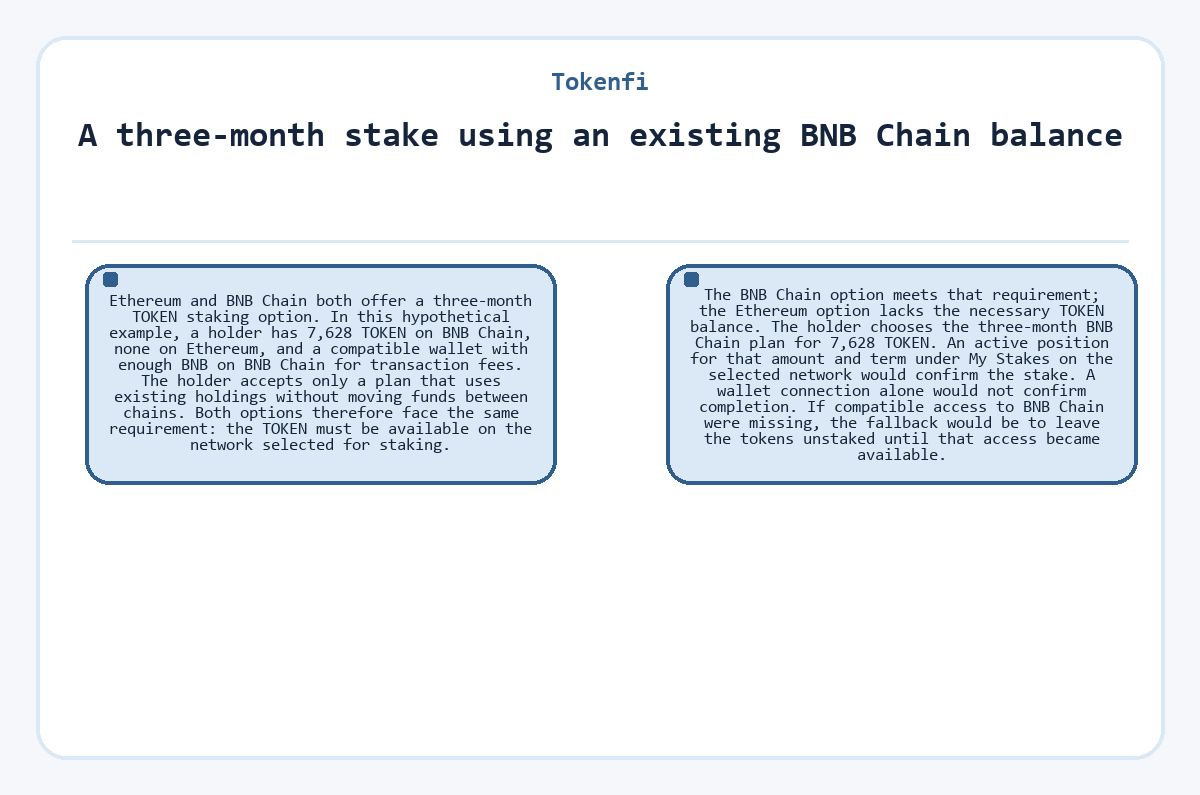
Ethereum and BNB Chain both offer a three-month TOKEN staking option. In this hypothetical example, a holder has 7,628 TOKEN on BNB Chain, none on Ethereum, and a compatible wallet with enough BNB on BNB Chain for transaction fees. The holder accepts only a plan that uses existing holdings without moving funds between chains. Both options therefore face the same requirement: the TOKEN must be available on the network selected for staking.
The BNB Chain option meets that requirement; the Ethereum option lacks the necessary TOKEN balance. The holder chooses the three-month BNB Chain plan for 7,628 TOKEN. An active position for that amount and term under My Stakes on the selected network would confirm the stake. A wallet connection alone would not confirm completion. If compatible access to BNB Chain were missing, the fallback would be to leave the tokens unstaked until that access became available.
Supercharger points alongside TOKEN rewards
Supercharger links staked TOKEN with early access and purchase allowances for select Launchpad fundraising sales. Its points govern participation benefits and are separate from TOKEN staking rewards.
Under the January 4, 2025, Supercharger rules, points depend on the stake amount and a duration multiplier. The program grants half the calculated points upfront, and the remaining half vests over the chosen term. That vesting affects participation benefits separately from the ability to claim TOKEN rewards.
That version lists multipliers of 1x for three months, 4x for one year, 8x for two years, and 16x for four years. These values scale Supercharger points; they do not express the TOKEN reward yield.
Tokenfi FAQ
Can I stake only part of my TOKEN balance?
The staking interface allows either part of the TOKEN balance or the full balance to be staked. TOKEN left outside the position remains outside that position's lock. Selecting a partial amount changes the staked quantity; it does not shorten the term chosen for those tokens.
Are unclaimed TOKEN rewards included in Supercharger points?
Unclaimed TOKEN rewards do not count as staked tokens for Supercharger points. Only eligible staked TOKEN contributes to the calculation.
How are multiple TOKEN stakes combined for Supercharger?
Supercharger calculates each stake's points separately, then adds them to the wallet's total. Each position retains its own amount and duration in that calculation.
Does staking FLOKI use the TOKEN staking reward pool?
Staking FLOKI and staking TOKEN belong to different reward programs. The tokenomics separately allocate TOKEN to FLOKI staking and to TOKEN staking. The 7% allocation refers to the TOKEN staking program. Sharing a reward ticker does not make the deposited assets or reward allocations interchangeable.
Will unstaking after the lock ends preserve my Supercharger points?
Unstaking after the lock ends removes the Supercharger points associated with that stake. Remaining staked preserves earned points under the January 4, 2025, rules.