 Tokenfi
 supports crypto token creation and permissioned asset issuance
Tokenfi provides no-code tools for creating crypto tokens and an RWA module for issuing permissioned tokens tied to real-world assets. In the RWA module, investor qualification and transfer restrictions govern participation. The wider product range includes fundraising, bulk token distribution, contract analysis, NFT artwork generation, and TOKEN staking, each serving a different part of a project.
Creating a crypto token and organizing an asset offering involve different requirements. The intended use determines the appropriate application and token standard. For an asset offering, investor access and ongoing administration also influence how the token operates after issuance.
Token Launcher, Launchpad, and the RWA module
Token Launcher, Launchpad, and the RWA Tokenization Module handle token creation, fundraising, and permissioned asset issuance, respectively. Token Launcher creates ERC-20 and BEP-20 tokens, ERC-721 NFTs, and ERC-1155 multi-token collections without requiring users to write code. Launchpad supports decentralized fundraising for tokens, while the RWA module extends issuance into investor qualification and ongoing asset administration. A token contract establishes the token's on-chain behavior, while a fundraising sale provides a route for raising project financing. An RWA offering connects digital tokens with an underlying asset and its investor requirements.
Issuance, fundraising, and token distribution
Launchpad and Nimbus address different ways of distributing project tokens: fundraising sales and airdrops to multiple wallets.
QuickLaunch Bot provides another token-creation interface through Telegram and Discord commands, including access from mobile devices.
The common platform name does not make a newly created project token the same asset as TOKEN. TOKEN has a separate role as the platform's utility token.
How do investor controls shape RWA ownership?
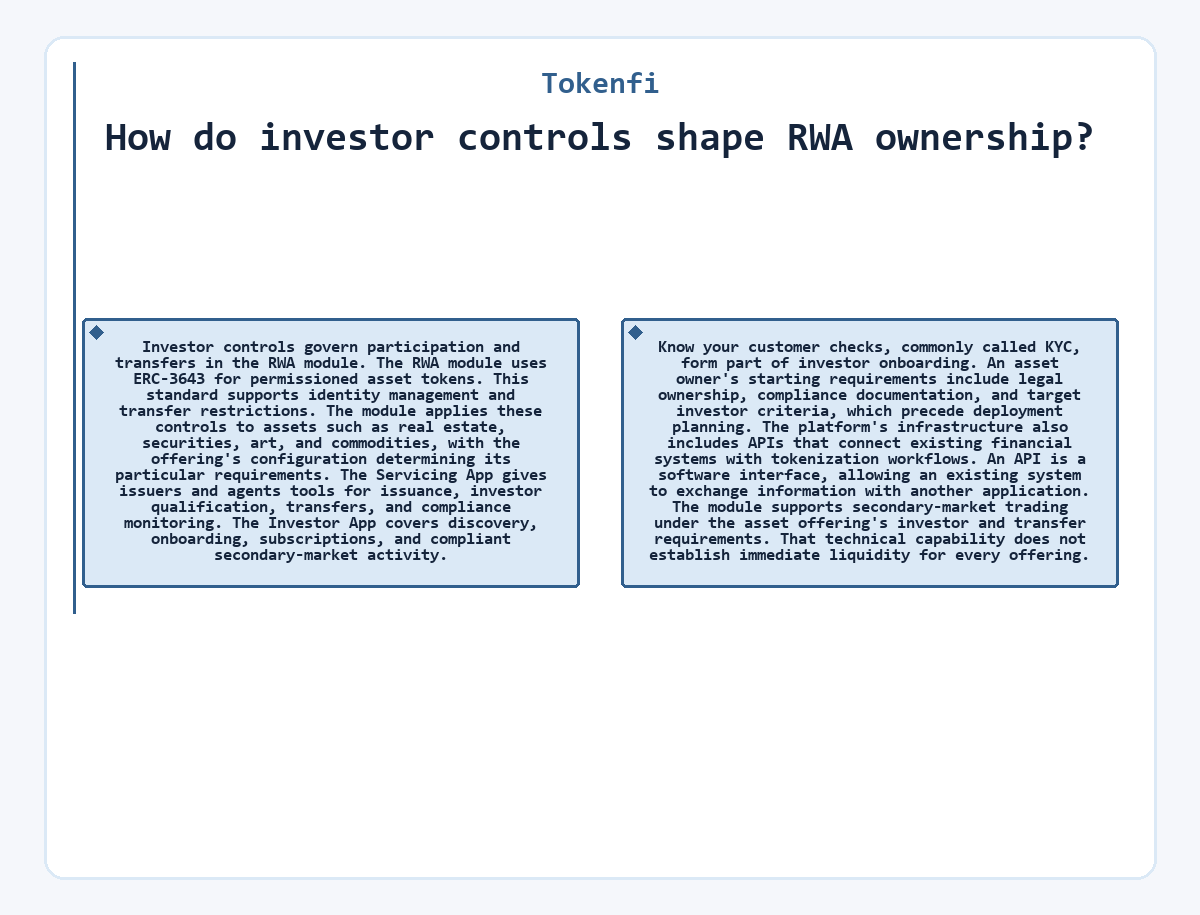
Investor controls govern participation and transfers in the RWA module. The RWA module uses ERC-3643 for permissioned asset tokens. This standard supports identity management and transfer restrictions. The module applies these controls to assets such as real estate, securities, art, and commodities, with the offering's configuration determining its particular requirements.
The Servicing App gives issuers and agents tools for issuance, investor qualification, transfers, and compliance monitoring. The Investor App covers discovery, onboarding, subscriptions, and compliant secondary-market activity. Know your customer checks, commonly called KYC, form part of investor onboarding.
An asset owner's starting requirements include legal ownership, compliance documentation, and target investor criteria, which precede deployment planning. The platform's infrastructure also includes APIs that connect existing financial systems with tokenization workflows. An API is a software interface, allowing an existing system to exchange information with another application.
The module supports secondary-market trading under the asset offering's investor and transfer requirements. That technical capability does not establish immediate liquidity for every offering.
Contract analysis and NFT creation
Shield analyzes smart contracts, while AIGen Studio combines artwork generation with NFT minting.
Shield uses AI to identify potential vulnerabilities, logic flaws, and optimization opportunities in uploaded contracts. It produces a shareable report whose findings relate to the submitted contract. Investor qualification and compliance monitoring remain separate functions within the RWA applications.
AIGen Studio uses AI to generate artwork and lets users mint it as NFTs, or non-fungible tokens, on BNB Smart Chain.
TOKEN utility and staking
The platform's utility token and staking program concern TOKEN holdings, separately from the assets that projects issue. TOKEN is the platform's main utility token. The project is controlled by the Floki DAO and led by the Floki Core Team. This governance context concerns the platform itself, rather than ownership of every token that its applications create.
The TOKEN staking application accepts TOKEN and distributes TOKEN rewards. FLOKI staking uses a different staked asset, even though both programs appear in the wider ecosystem. Neither staking program is available to the public of Hong Kong.
Fundraising tools and planned connections
Launchpad supports fundraising, while Connect is listed as coming soon for introductions to investors, influencers, and thought leaders.
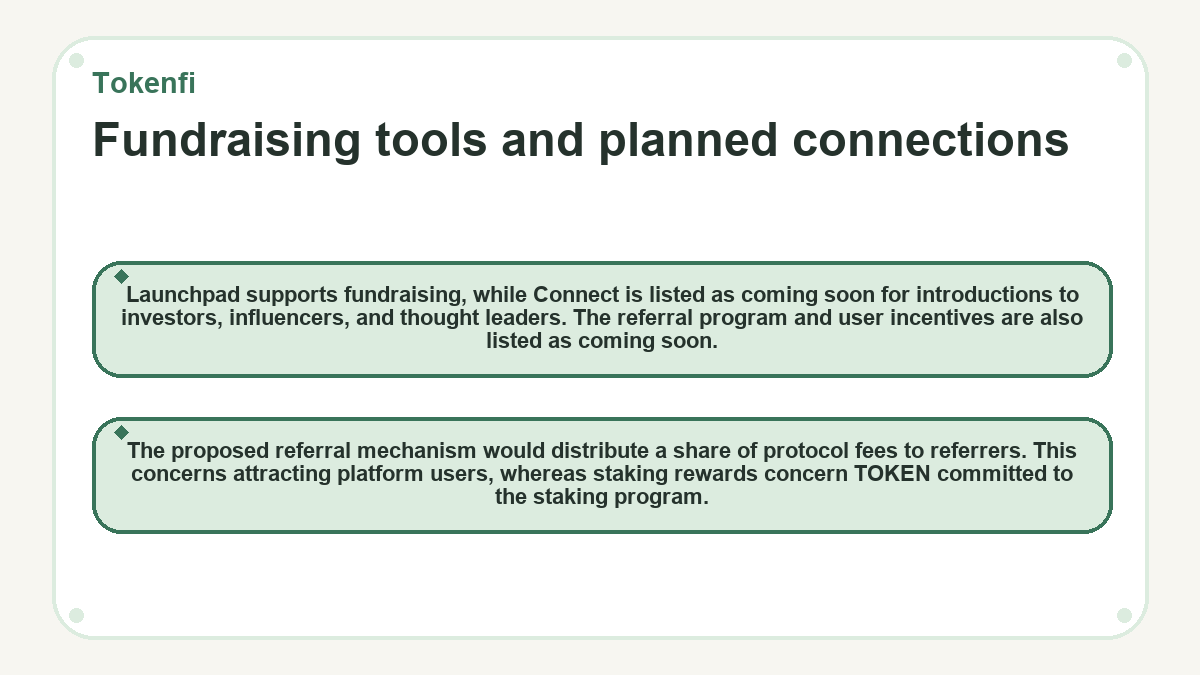
The referral program and user incentives are also listed as coming soon. The proposed referral mechanism would distribute a share of protocol fees to referrers. This concerns attracting platform users, whereas staking rewards concern TOKEN committed to the staking program.
Requirements beyond token creation
An RWA offering requires asset and investor administration alongside its token contract.
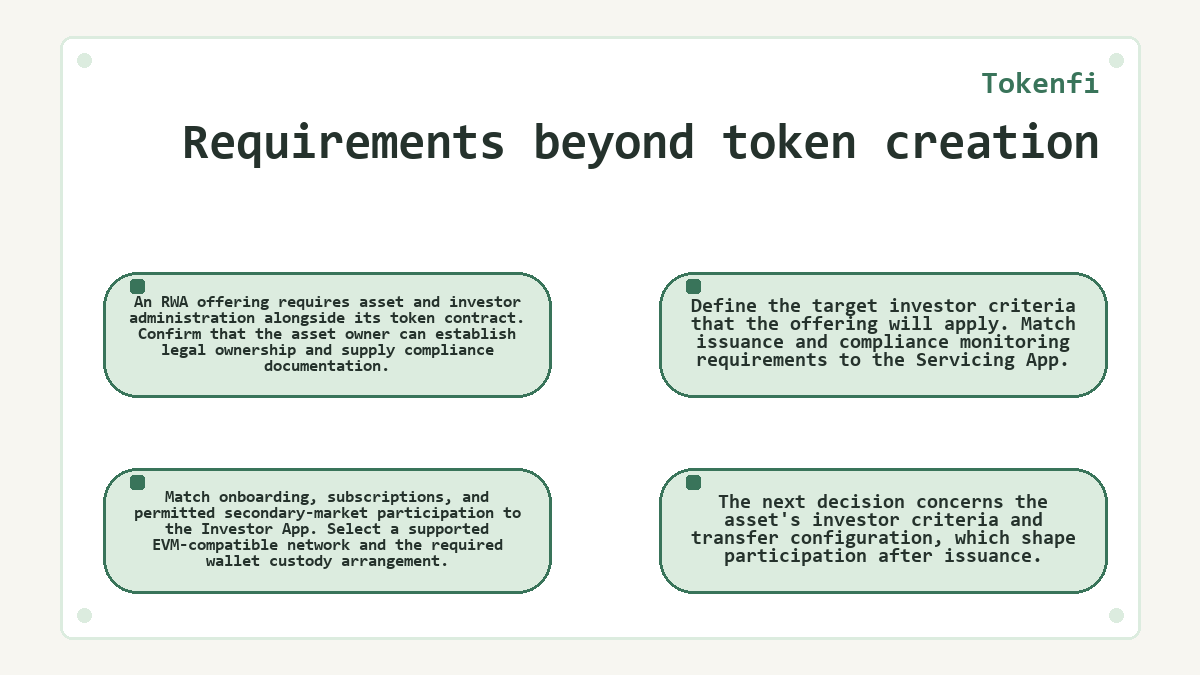
- Confirm that the asset owner can establish legal ownership and supply compliance documentation.
- Define the target investor criteria that the offering will apply.
- Match issuance and compliance monitoring requirements to the Servicing App.
- Match onboarding, subscriptions, and permitted secondary-market participation to the Investor App.
- Select a supported EVM-compatible network and the required wallet custody arrangement.
The next decision concerns the asset's investor criteria and transfer configuration, which shape participation after issuance.
Tokenfi: common questions
How is an RWA project priced?
RWA implementation pricing is customized to the project's requirements. Primary-market investment charges can be fixed fees or percentages of the net investment. A fixed fee adds a set amount, while a percentage scales with that investment. Secondary-market transfer fees apply to transfers between investors.
Which wallets can hold tokens issued through the RWA module?
The RWA module supports custodial, noncustodial, and self-hosted wallet arrangements. Custody describes who controls the wallet; investor eligibility governs who can participate in an offering. Choosing a self-custody wallet does not bypass the offering's qualification or transfer rules.
Can RWA tokens trade immediately after issuance?
RWA trading availability depends on the asset's configuration and local regulations. The module supports secondary-market functions, but issuance alone does not establish that trading has opened. Investor qualification and the applicable transfer rules also remain relevant when a secondary transaction is attempted.
Does the 7% staking allocation mean a 7% annual yield?
The 7% figure describes the share of the total TOKEN supply allocated to the TOKEN staking program at launch. It is an allocation, not an annual percentage yield. An individual staking return depends on the program's reward terms and selected staking duration.
Where can the RWA module deploy its tokens?
The RWA module supports EVM-compatible networks, including Base, Polygon, Arbitrum, and Avalanche. EVM means Ethereum Virtual Machine, the execution environment that these networks support. This network support belongs to the RWA module; other applications within the product range have their own supported network lists.
Are tokenized assets always redeemable for cash?
Cash redemption depends on whether the asset offering provides a redemption option. The ability to hold or transfer an RWA token does not establish that cash redemption is available. Redemption and secondary-market trading are separate routes, with their own applicable terms.
When may an RWA issuer pause trading?
The RWA module includes issuer controls that can pause trading for security or compliance. A token's presence in a wallet does not, by itself, establish that trading is open.